Homily for Divine Mercy Sunday: The Mission of Mercy
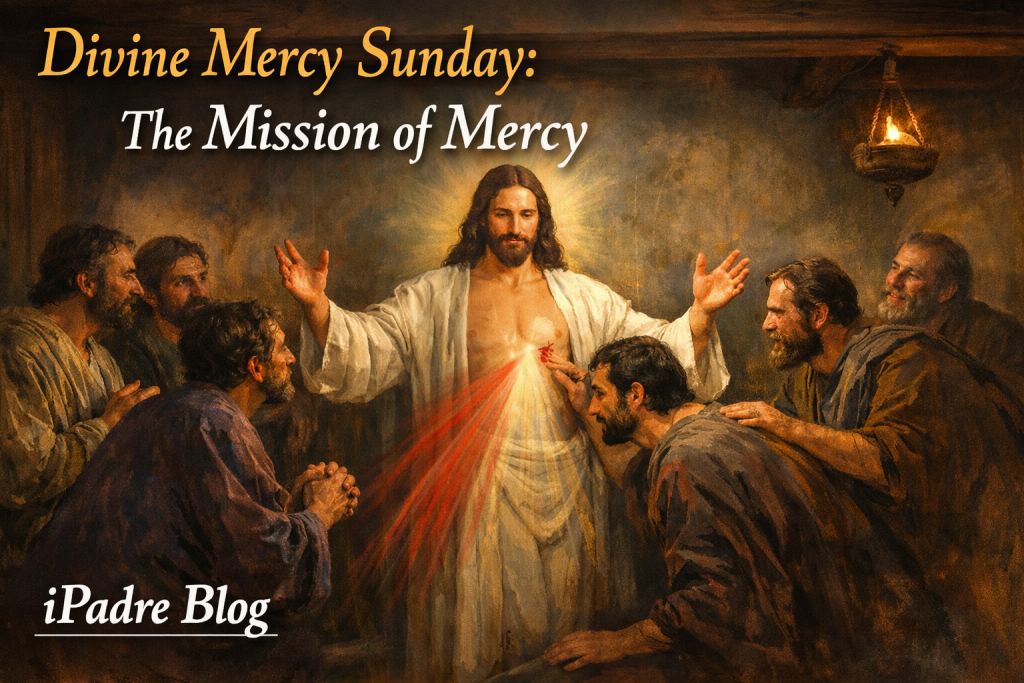
We often think of the Great Commission as that moment when Our Lord sends the Apostles forth to preach and to baptize. Yet the mission He entrusts to them is deeper and more profound than that single passage alone reveals. In the Gospel proclaimed on this Divine Mercy Sunday, given on the very evening of Easter, we see not only the sending of the Apostles, but the very heart of how that mission is to be carried out.
The Apostles are sent by Christ to continue His very mission. Our Lord declares to them, “As the Father has sent me, so I send you.” This is not a task they take upon themselves, nor is it a mission born of human initiative. It is given—conferred—by Jesus Christ Himself. Just as the Son was sent by the Father to reconcile the world, so now the Apostles are sent to continue that same work of reconciliation. This is not symbolic language, but a real participation in the authority and saving work of Christ. The Church is not self-appointed. She did not invent her mission, nor did she create her purpose. She is sent, mandated with the very authority of Christ Himself.
On Holy Thursday, Our Lord Jesus Christ instituted the New Testament priesthood. Now, on the evening of Easter, He returns to His Apostles and, as the Gospel tells us, “He breathed on them.” This is no ordinary gesture. It recalls the moment in Genesis when God breathes life into man. Here, the Risen Christ breathes new life into His Apostles, imparting to them a distinct outpouring of the Holy Spirit for a particular purpose. While we often think of Pentecost as the singular moment of the Spirit’s coming, the Scriptures reveal multiple moments in which the Church is strengthened, equipped, and commissioned.
The purpose of this moment is unmistakable. “Receive the Holy Spirit. Whose sins you forgive are forgiven them, and whose sins you retain are retained.” These are not merely comforting words, nor are they a general proclamation of forgiveness. They constitute a solemn and juridical act—the conferral of real authority. The Apostles are entrusted with the ministry of reconciliation itself. Once again, we see clearly: the Church does not establish her mission, the Church does not create her purpose, and the Church is not self-appointed. She is commissioned, empowered, and sent by the Anointed One, Our Lord Jesus Christ. It is His Church, and it is His mission that continues through her in every age.
This Gospel, however, is not only about the Apostles. It speaks directly to each one of us. It reminds us that the means of reconciliation is not a later development or a human invention. It was not devised in the Middle Ages, nor gradually constructed over time. It comes directly from the will of Christ Himself, expressed clearly on that Easter night in the Upper Room.
If Christ has instituted the Sacrament of Forgiveness, then we are called to conform ourselves to His will, not our own. We cannot simply say, “I will confess directly to God,” while disregarding the very means He has established. To do so is not humility, but presumption. Christ has made His will known. He has given us the path. He has entrusted this ministry to His Church so that we might encounter His mercy with certainty and grace.
If it has been some time since your last confession, then come. Come and receive the mercy that Christ Himself has instituted. Do not take chances with something as serious as eternal salvation. Do not rely on your own way when Christ has given us His. He is the One who established the Sacraments, and it is He who binds us to these means of grace. Come and know the love and mercy of God, a mercy poured out abundantly in this great Sacrament. Come, and receive His peace.
Comments
Homily for Divine Mercy Sunday: The Mission of Mercy — No Comments
HTML tags allowed in your comment: <a href="" title=""> <abbr title=""> <acronym title=""> <b> <blockquote cite=""> <cite> <code> <del datetime=""> <em> <i> <q cite=""> <s> <strike> <strong>